
 |
|||
|
|||
 |
 |
|||
Transport & Infrastructure S - Solar roadways | Solar hybrid vessels
|
|||
 |
|||
|
||
Evacuated tube transport
Hypersonic
airliners These aircraft would have a cruising speed of Mach 5 - or 3,800 mph - allowing them to fly from Europe to Australia in less than four hours. With a range of more than 20,000 km (12,000 miles) they could perform this journey without refuelling. They would have excellent subsonic and supersonic fuel efficiency, avoiding the problems inherent in earlier supersonic aircraft. Furthermore, and perhaps more importantly, hypersonic airliners will be environmentally friendly. Powered by liquid hydrogen, their only waste products will be water vapor and small levels of nitrous oxide. Another advantage is that, while the 150m-long designs will be larger than previous jets, they will actually be lighter than Boeing 747s and could utilise conventional airport runways. They will have moderate take-off noise, too. In many ways, they will be the spiritual successor of Concorde. The craft will likely be windowless, however. The heat generated by traveling so fast will make it difficult to install windows that are not too heavy. One solution to this problem might be the installation of flat screen displays projecting images of the scene outside.
Solar
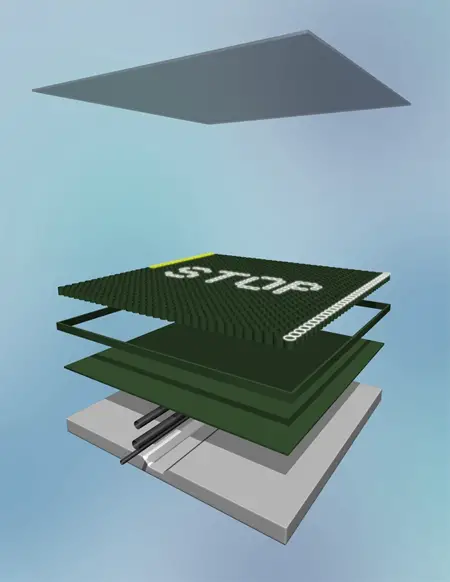
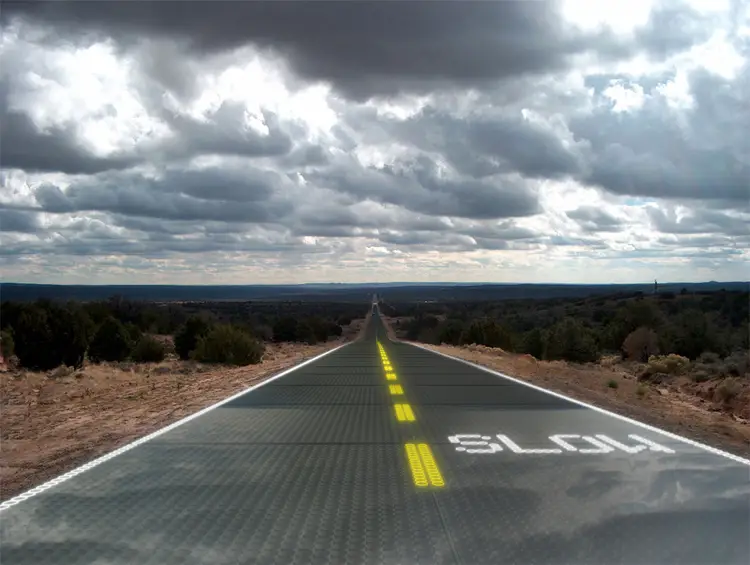
roadways Besides the production of clean energy, these hi-tech surfaces would have other advantages. In northern climates, for example, they could heat themselves with embedded heating elements (similar to the rear window of a car), eliminating ice and snow buildup. Cities would no longer have the expense of snow removal and the problems caused by the chemicals (salt, magnesium chloride, etc.) used to maintain clear roads. Businesses would no longer have to worry about keeping their parking lots cleared, while homeowners would no longer have to suffer through winters of shovelling or ploughing snow off their driveways and sidewalks. A large number of deaths and injuries would be prevented just by keeping the roads safe and dry. LED signage could be built in, creating "smart" roads that dynamically responded to traffic, weather, emergencies and other events. For example, if an animal tried to cross, oncoming drivers would be instantly alerted and given plenty of time to slow down.
Electric vehicles would benefit tremendously. They could be recharged at any conveniently located rest stop, or at any business incorporating solar road panels in their parking lots. Owners could plug their cars in and recharge them while shopping or dining out. Solar roadways would offer a decentralised power source - replacing all of our current centralised power stations. Roads and pavements would become the power grid, producing a secure and stable network of energy that would be impossible to shut down by terrorists or anybody else. The days of widespread power outages would be history. The need for unsightly utility poles and relay stations would also be eliminated. It would take roughly five billion 12' by 12' solar road panels just to cover the roads, parking lots and driveways in the USA. Imagine the manufacturing requirements: so many new jobs would be created that it might very well become the "New Deal" of the 21st century. Workers could be retrained from obsolete jobs such as coal miners and asphalt workers with new "green collar" jobs. Unemployment rates would plummet. Vast sums of money would be injected back into the economy. Given the political will and financial commitment, this revolutionary technology could produce the biggest mobilisation of workers since WWII. At least one organisation in the USA has obtained funding to develop prototypes. Solar Roadways, run by Scott and Julie Brusaw, has been awarded a $100,000 research contract by the US Department of Transportation.*
Solar
hybrid vessels Both peak oil and global warming have spurred efforts to create new and more efficient ship transport systems. There are many technical and operational means by which this is being achieved. These include new propeller and rudder designs, more flexible use of engines, waste heat recovery, better route planning, improved weather routing systems and autopilots, speed optimisation and improved slot time and turn-around systems in ports and canals. A more exciting, innovative and longer-term solution is the use of solar and hybrid technologies. The car industry is already beginning to go electric, with a majority of new vehicles predicted to be electric or hybrid-electric by 2030. Eventually, the shipping industry could see widespread adoption of electric too.
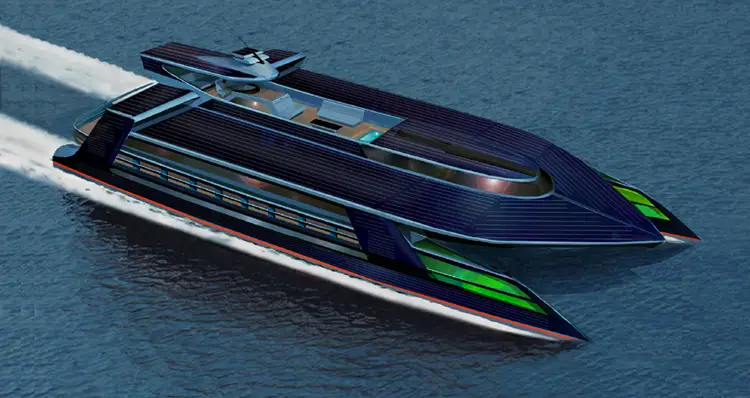
Electric boats became popular in the 1880s, a trend that continued until the 1920s, when internal combustion engines took dominance. Since the energy crisis of the 1970s, interest in this quiet and potentially renewable marine energy source has been increasing steadily again, especially as solar cells are now available - making possible motorboats with unlimited ranges like sailboats. The first practical solar boat was constructed in 1975 in England. The first commercial solar passenger boats appeared in Switzerland in 1995, capable of short excursions on lakes. The first crossing of the Atlantic Ocean by a solar boat was achieved in 2007 by the 14m (46ft) long catamaran Sun21.* Another milestone was achieved in 2009 when the first cargo ship to use solar power was launched in Japan. The 60,000 ton, 200m (660ft) vessel can generate 40 kilowatts of solar power, which covers only 0.2% of the ship's energy for propulsion, but its company hopes to increase this ratio.* As of 2011, the Tûranor PlanetSolar is the world's largest 100% solar powered boat, with a length of 31m (101ft) and a maximum speed of 14 knots (26 km/h). Powered by 470 square metres of solar panels, it is set to circumnavigate the Earth, stopping at cities along the way to raise public awareness of renewable energy. As solar power becomes cheaper and more efficient, companies are now looking to the future with a number of more advanced design concepts emerging. One such company is Sauter Carbon Offset Design. Its primary objective is "...to reduce GHG emissions by 50 to 100% in boats by optimizing and applying the full range of well-established technology in shipbuilding, and when applicable to employ the cutting edge advances to come out of the automotive and aerospace industry." As illustrated on their website, solar isn't the only form of alternative energy that can be applied to ship transport. Assisting sails and/or giant kites utilising the wind can be incorporated too. In optimal weather conditions and using the right materials and setup, these could offer surprisingly strong power.* Energy from passing waves captured by Motion Damping Regeneration (MDR) could also be used.
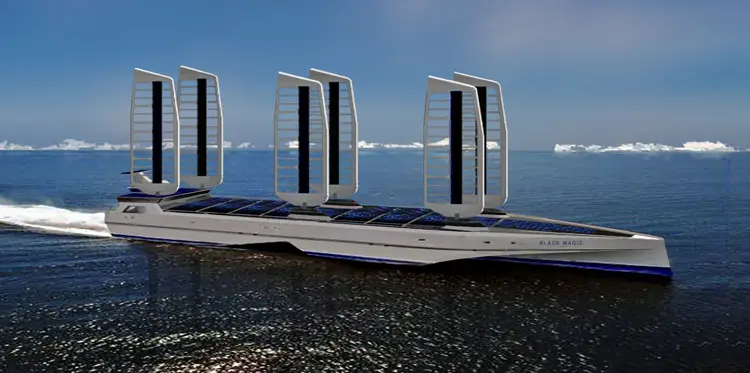
As oil continues to decline, perhaps even disappearing within 50 years, larger bulk carriers may transition to solar and hybrid technology. Below is one such concept. The "Black Magic" tanker is a 125m long solar hybrid vessel that would cut greenhouse gas emissions by 75 to 100% - harnessing energy from the Sun, wind and waves to charge a lithium-ion storage system.*
Transatlantic
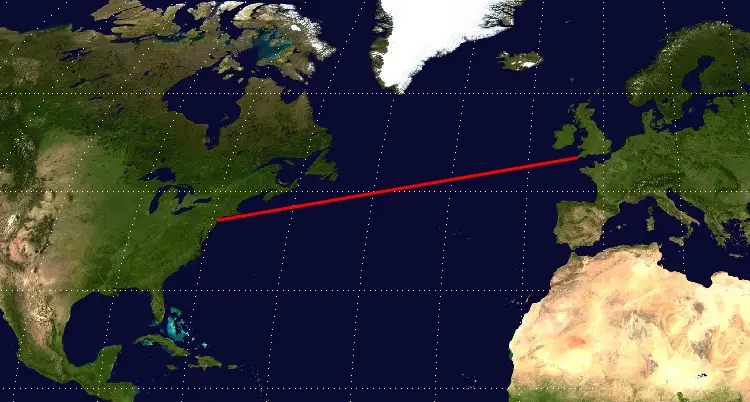
tunnel Through the use of nanotechnology, automation and robots, the tunnel could be built surprisingly quickly. It would be controlled largely by AI. Carbon nanotubes and powerful geo-sensing devices would be paramount in the structure's design; these could self-adjust in the event of undersea earthquakes, for example. The trains would use a maglev system and would operate in a complete vacuum. This would eliminate air friction, enabling them to reach hypersonic speeds. The cost of such a project would be in the region of $88-175bn.*
|
||
|
||

 Share
Share |
||
|
References 1 Evacuated Tube Transport Technologies, et3 Network: 2 Reaction
Engines A2, Wikipedia: 3 Solar-powered 'smart' roads could zap snow, ice, CNN: 4 Shipping CO2 emissions - Technical solutions and abatement potential, International Maritime Organization (IMO): 5 "Volcanoes release more than 130 million tonnes of CO2 into the atmosphere
every year." 6 As Shipping Emissions Increase, Cool New Designs Emerge, Climate
Progress: 7 Solar boat makes Atlantic history, BBC: 8 Japan launches first solar cargo ship, Solar Daily: 9 Ocean Empire, Sauter Carbon Offset Design: 10 Black Magic Tanker, Sauter Carbon Offset Design: 11 Extreme Engineering: Transatlantic Tunnel, Discovery Channel: 12 Trans-Atlantic MagLev, Popular Science:
|
||
|
||
|
|||
|
|||
|

 |
Follow us »
|
 |


|
|
Latest prediction »
Latest blog »
|
|
|
|
|
Visit our forum »
|
|
|

|
|
|
|
|
|
